
The Cinematic State: How Power Is Built—and Sold—in Modern Canada
“Confidence is the product. Policy is just the packaging.”

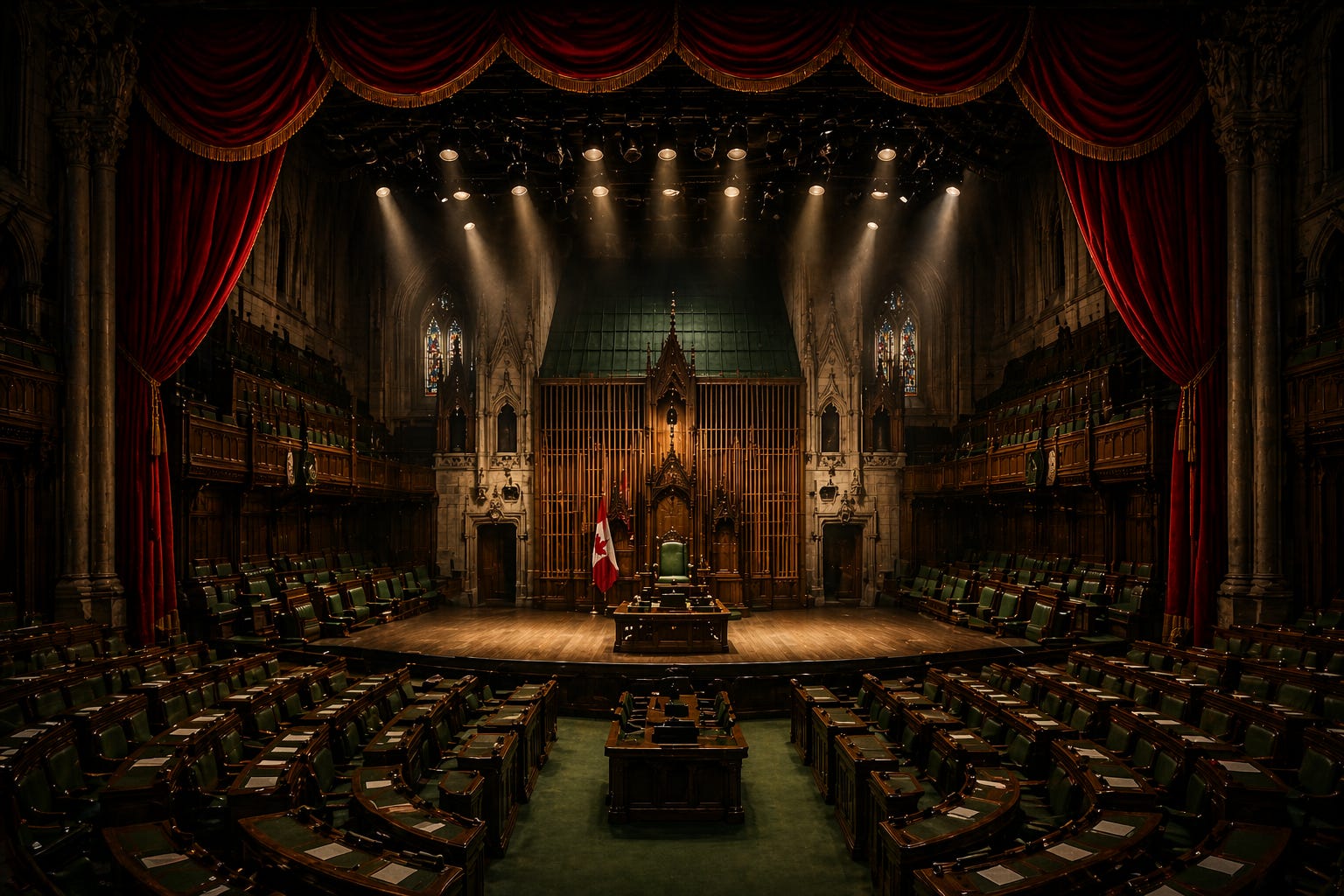
There was something striking about the speech.
Not just the content, but the production.
It didn’t feel like a policy address. It felt like a cross between a wartime broadcast, a heritage documentary, and a high-end campaign reel.
That wasn’t accidental.
Because what we’re watching unfold isn’t just economic policy.
It’s economic storytelling, and more importantly, economic conditioning.
Act I : The Machine
Manufacturing the Crisis
The structure is familiar:
The world is more dangerous
The United States is unreliable
Canada is exposed
The future is uncertain
This is not analysis. It’s scene-setting.
Once instability is accepted as the baseline, the conclusion becomes inevitable:
We need coordination. We need direction. We need control.
As Milton Friedman famously observed:
“Only a crisis—actual or perceived—produces real change.”
The function of crisis, real or exaggerated, is to justify the expansion of centralized authority.
Replacing Markets with “Guidance”
Buried in the speech is the most revealing admission:
Forward guidance… acting with “overwhelming force.”
This is central bank language, refined, polished, and deployed at a national level.
Here’s what it means in practice:
Don’t let markets discover reality
Tell markets what reality will be
Shape expectations
Let behavior follow belief
Friedman would call this what it is:
”the substitution of narrative for price signals.”
Markets are messy, but honest.
“Guidance” is smooth, but constructed.
Centralizing the System
One line should have stopped the room cold:
“One Canadian economy out of thirteen.”
That is not a slogan. That is a structural shift.
Canada has historically functioned through distributed strength:
Provinces compete
Policies differ
Risk is localized
This proposal moves in the opposite direction:
Standardization
Alignment
Central coordination
Through the lens of Richard Werner, this is more than administrative reform:
It creates the conditions for centralized credit allocation.
Because once policy is unified,
capital can be directed—quietly, efficiently, and politically.
The Trillion-Dollar Question
We’re told:
A trillion dollars in investment will be “catalyzed.”
That word—catalyzed—is doing heavy lifting.
Because capital doesn’t appear out of nowhere.
It comes from:
Pension funds
Bank-created credit
Government guarantees
Institutional capital
Werner’s core insight is simple and uncomfortable:
Banks don’t lend money—they create it.
So when governments “catalyze” investment, they are often:
Steering credit into preferred sectors
Inflating asset values
Socializing risk (while Privatizing Profits)
This is not free-market investment.
It is guided capital deployment.
The Pivot to “Values”
Then comes the most slippery shift:
“We have the values the world aspires to.”
At first glance, it sounds admirable.
But this is where economics leaves measurement and enters moral framing.
And once policy becomes “values-based”:
Opposition becomes morally suspect
Trade-offs disappear
Outcomes become secondary to intent
Friedman built his framework on measurable outcomes:
Prices
Incentives
Efficiency
“Values” don’t appear in price signals.
But they appear everywhere in justifications for control.
The Great Inversion
We’re told:
“We are taking back control.”
It sounds empowering.
But structurally, what’s being described is:
More centralization
More coordination
More institutional control
So who is taking control?
Not individuals.
Not small businesses.
Not provinces.
Control shifts upward, to planners, institutions, and policy-makers.
What is presented as decentralization is, in reality, consolidation.
Transition From Policy to Story
But policy alone doesn’t move a country.
People don’t follow balance sheets.
They follow stories.
And this is where the speech becomes something else entirely.
Act II : The Myth
The Prop on the Desk
There’s a detail that would be easy to overlook if it weren’t so deliberate:
A figurine of Isaac Brock sits prominently on the desk.
A military hero. A symbol of unity. A defender of the nation.
On its own, it’s harmless.
In context, it’s instructive.
Because symbolism is never neutral.
The Missing Builders
If the theme is “Canada Strong” if this is about building, investing, and shaping the future then the omission is striking.
Where is John A. Macdonald?
The architect of Confederation.
The man who drove the transcontinental railway.
The builder of the nation itself.
Where is Wilfrid Laurier?
The leader who declared:
“The 20th century shall be the century of Canada.”
And more importantly:
“Canada is free, and freedom is its nationality.”
These are not minor oversights.
They are philosophical omissions.
Why Military Figures?
Military figures do something politically useful:
They unify
They simplify
They eliminate ambiguity
War has:
Clear enemies
Clear objectives
Clear command structures
It’s emotionally powerful, and politically efficient.
But political founders complicate things.
Macdonald represents:
Federalism
Risk
Compromise
Laurier represents:
Freedom
Liberty
Individualism
Those ideas introduce limits.
And limits are inconvenient when the message is:
We need alignment. We need coordination. We need unity.
From Freedom to Unity
What you’re seeing is a shift:
From freedom → to resilience
From individual liberty → to collective strength
From decentralized building → to coordinated action
Military symbolism reinforces this shift.
Because in wartime:
Unity outranks dissent
Coordination outranks autonomy
Obedience outranks debate
That framing matters.
The Toy and the Tension
And then there’s the object itself.
Not a document.
Not an artifact.
A figurine.
A simplified, stylized version of history, something curated, positioned, and presented.
It invites a line that’s difficult to ignore:
“When I was a child, I spake as a child… but when I became a man, I put away childish things.”
This isn’t about mockery.
It’s about contrast:
The complexity of the economic transformation being proposed
The simplicity of the imagery used to frame it
A serious shift…
presented through symbolic shorthand.
Final Analysis: The System and the Story
Put both acts together, and the pattern becomes clear.
This is not a radical break.
It’s something more effective:
A quiet shift.
From markets → managed outcomes
From price signals → narrative signals
From decentralization → coordination
From economics → “values”
Through a Werner lens:
Credit direction without transparency.
Through a Friedman lens:
The replacement of markets with managed expectations.
Final Thought
Strip away the cinematic lighting.
Remove the historical callbacks.
Ignore the emotional cues.
What remains is this:
Not a plan to restore markets;
but a plan to guide them.
Not a call to decentralize power;
but a framework to concentrate it.
And not just through policy;
but through story.
Because when you control both the system and the narrative,
you don’t just manage an economy.
You shape how a nation understands itself.
And once that happens power no longer needs to announce itself.
It simply operates.
Please share, copy and send to those you think would find this interesting.
This PM and his government terrify me.