
The Standing Ovation Trap

“The object of power is power.”
George Orwell, 1984
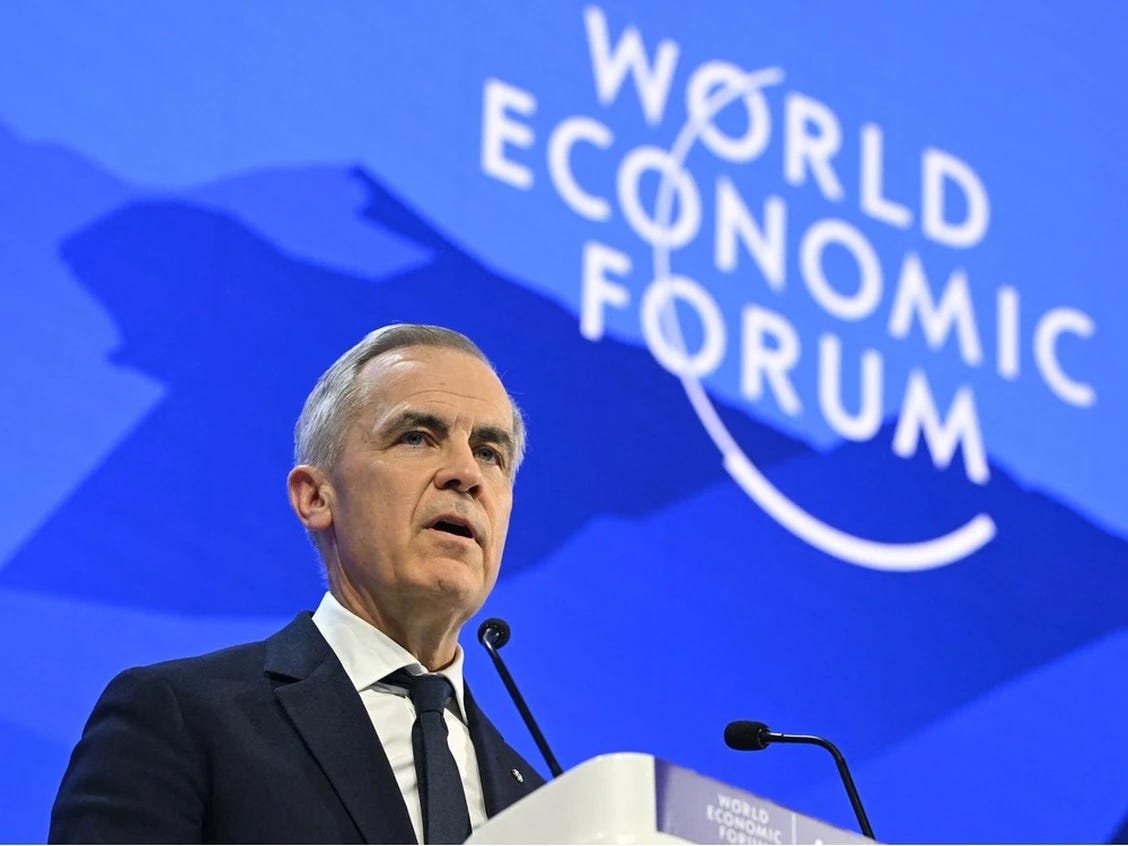
Mark Carney’s World Economic Forum speech will be remembered for its applause. It shouldn’t be.
The standing ovation at the WEF will be cited as proof of brilliance, but it obscures a deeper shift Carney has been outlining for years — one that redefines sovereignty, democracy, and economic governance itself.
We should not, in fact, be surprised by it at all.
Carney outlined this worldview years ago in Value(s). The WEF speech is not a departure from that book; it is its execution.
In Value(s), Carney explicitly challenges the classical understanding of sovereignty as something grounded in constitutional law and democratic consent. Citing Mario Draghi approvingly, he argues that sovereignty is not “the power of making laws,” but the ability to control outcomes and respond effectively to pressure. Sovereignty, in this framework, is functional rather than constitutional.
That idea appears almost verbatim in the WEF speech, where sovereignty is redefined as the capacity to “withstand pressure.”
This is not a semantic adjustment. It is a structural shift.
Once sovereignty is measured by resilience rather than consent, the purpose of government changes. Law becomes a tool rather than a constraint. Democratic process becomes conditional — tolerated when it aligns with resilience, bypassed when it does not.
That shift is not academic. It changes everything downstream.
Crisis as the Governing Condition
In Carney’s framework, crises are not exceptions. They are the permanent environment of modern governance.
Economic pressure, trade retaliation, climate risk, cyber threats, pandemics — these are not episodic challenges to be managed within normal democratic constraints. They are standing justifications for speed, coordination, and discretionary authority.
This is why Value(s) consistently praises delegated authority, independent bodies, regulatory alignment, and soft law over hard law. All are defended as necessary responses to complexity and risk. All operate at arm’s length from direct democratic accountability.
The WEF speech removes the remaining ambiguity and states the conclusion plainly: the old consent-driven, rules-based order is finished. Adapt or be subordinated.
Pensions, Capital, and Jobs
This is where abstraction ends.
In a pressure-based system, pension funds are no longer neutral stewards of retirement savings. They become instruments of national strategy, steered toward “resilient” outcomes rather than risk-adjusted returns. Capital allocation follows political priorities and regulatory nudges rather than productivity and price signals.
Businesses are governed less by clear legislation and more by coordinated regulatory pressure — alignment across institutions that are formally independent but substantively unified.
Jobs follow the same logic. Employment is no longer primarily the result of market demand. It becomes the product of managed priorities: strategic sectors, national objectives, crisis responses.
For workers, this means volatility wrapped in purpose.
For retirees, it means pension security tied to policy success.
For employers, it means political risk replacing legal certainty.
Why Pressure Must Be Maintained
Here is the key point: this system requires pressure to function.
If emergencies end, discretionary power recedes. If courts reassert limits, managerial authority contracts. If citizens successfully resist, legitimacy shifts back to consent.
Seen through that lens, recent events align.
Carney’s role during the Truckers Freedom Convoy was not incidental. The use of the Emergencies Act followed the logic of pressure-based sovereignty: redefine protest as systemic risk, invoke economic threat, and justify extraordinary measures through necessity rather than law.
That is precisely why the recent Federal Court of Appeal decision matters. The court did something dangerous to the managerial model: it reaffirmed that emergencies have legal thresholds, and that executive convenience does not meet them.
The ruling does not merely constrain a past action. It threatens the continued availability of the tool itself.
And in a system that depends on emergency powers remaining credible, even as a latent threat, losing that tool is intolerable.
The rushed announcement of the firearms confiscation program follows the same pattern: compressed timelines, minimal consultation, administrative process substituting for legislative debate. Citizens are treated not as rights-holders, but as compliance risks. Necessity once again replaces consent.
The Orwellian Mechanism (Used Properly)
This is where 1984 becomes relevant — not as metaphor, but as mechanism.
Orwell’s warning was not primarily about surveillance or brutality. It was about the maintenance of permanent crisis. When Oceania’s enemy changed, the public was told, “We have always been at war with Eastasia.” The purpose was not to convince, but to normalize instability and suppress the question of consent.
Modern pressure-based governance works the same way. The threats rotate — inflation, trade shocks, extremism, climate urgency, disinformation — but the logic remains constant. Each new pressure is presented as if it has always justified extraordinary measures.
What is managed is not truth, but memory.
Yesterday, protests were democratic expression.
Today, they are systemic risk.
Yesterday, trade friction was negotiation.
Today, it is existential threat.
And when challenged, the response is effectively: this has always been about resilience.
Antagonism as Catalyst
Seen through this lens, Carney’s broader conduct becomes revealing.
The pseudo trade missions, symbolic global alignments, and rhetorical antagonism toward the United States risk provoking retaliation from a president known to respond forcefully — Donald Trump.
Why does that matter?
Because retaliation creates pressure.
And pressure sustains emergency governance.
A permanent economic emergency allows sovereignty to be exercised through administrative power rather than constitutional law. The rule of law does not disappear — it is subordinated to resilience.
The Applause Problem
This is the danger of applause politics.
Standing ovations are taken as proof of legitimacy, when they are merely signs of elite approval. Voters never consented to this redefinition of sovereignty. Parliament never debated it. Courts are now pushing back against it.
Yet the model advances — efficiently, politely, and to thunderous applause.
This is not a theory.
It is a model.
And it is no longer being proposed.
It is being tested.
This is a fine explanation, Bryan. I am angry enough to spit nails. My sense is that he and his ilk care nothing for the citizens of this country (or any other for that matter.)
Oh, so Carney, bagman for the Commonwealth, will end up using this new development in world affairs as justification for greater government control of the people, the government and the economy of Canada.
Sounds about right.
Then again, when you're a hammer, everything looks like a nail.